
Why Your Bullet Points Are Making Things Worse
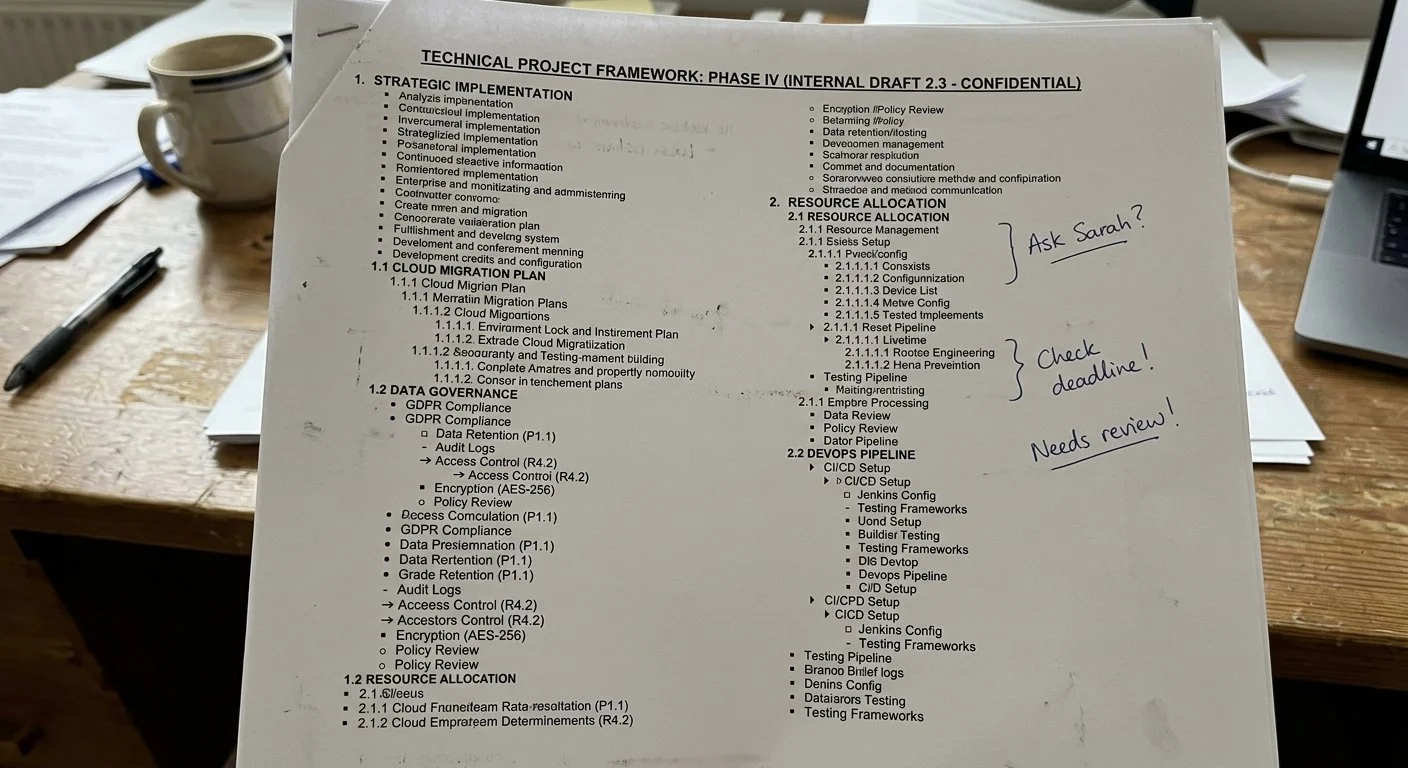
Bullet points feel productive. They look organized. They signal that you have taken a complex subject and broken it into manageable pieces. In a world where everyone is skimming, they seem like the considerate choice.
They are also one of the most overused formatting tools in professional writing, and when they are overused, they do not clarify. They fragment.
How bullet points became the default
At some point, the advice to "make your writing scannable" got translated into "put everything in lists." Presentation culture reinforced it. Slide decks trained an entire generation of professionals to reduce ideas to three words per line. Email culture rewarded brevity. And somewhere along the way, the bullet point stopped being a formatting tool and became a substitute for writing.
The result is documents, emails, and reports that look organized but are actually harder to follow than prose would have been. Because bullet points do not show relationships between ideas. They just place them next to each other and leave the reader to figure out how they connect.
What bullet points are actually good for
Bullets work when the content is genuinely list-like. When the items are parallel, discrete, and do not depend on each other to make sense.
A list of required documents for an application. A set of action items from a meeting. A checklist of steps in a process where order matters. A comparison of features across two options. These are situations where a list serves the reader because the content itself is a list.
The formatting matches the structure of the information. That is when bullets earn their place.
What bullet points do to reasoning
Here is where most professional writing goes wrong. Bullets get applied not just to list-like content, but to arguments, explanations, analyses, and narratives. And those do not survive the translation.
When you take a line of reasoning and break it into bullets, you strip out the connective tissue. The words that show how one idea leads to another. "Because," "therefore," "however," "as a result," "which means that" — these are the words that carry the logic of an argument. Bullets remove them. What is left is a series of statements with no visible relationship to each other.
The reader sees the points. They do not see the thinking behind them. And they are left to reconstruct the argument on their own, which is the opposite of what good writing is supposed to do.
The three-word bullet problem
This version is the most common and the most damaging:
Improved efficiency
Increased engagement
Reduced costs
What does any of that mean? Improved efficiency how, and compared to what? Increased engagement among which audience, and why does it matter? Reduced costs by what mechanism?
Three-word bullets compress meaning to the point of uselessness. They look like conclusions but they are actually just labels. The reader walks away with the impression of information without any of the substance.
This format is everywhere in business writing because it looks decisive and confident. It is neither. It is a way of gesturing at ideas without actually communicating them.
How to know whether to use bullets or prose
Ask one question: do these items connect to each other, or do they stand alone?
If they stand alone, a list is probably fine. A list of project deliverables does not need transitional language. Each item is its own thing.
If they connect, they need prose. If you are explaining why something happened, how a decision was reached, what the implications of a finding are, or why one option is better than another, that is an argument. Arguments need sentences. They need the words that show causation, contrast, sequence, and consequence. Bullets cannot carry that weight.
A useful test: try writing the content as a paragraph first. If the paragraph is awkward and the items genuinely do not flow together, a list might serve better. If the paragraph reads clearly and the reasoning holds together, leave it as prose. The bullet version will almost always be weaker.
What over-bulleted writing signals to the reader
A document that is mostly bullets reads as a set of notes rather than a finished piece of thinking. It signals that the writer has assembled the raw material but has not yet done the work of synthesizing it into a coherent point of view.
Readers may not articulate that reaction, but they feel it. The writing seems thin. The argument seems underdeveloped. The writer seems less authoritative than they would if they had written the same content in clear, connected prose.
Bullets can hide weak thinking behind the appearance of organization. Prose cannot. That is precisely why prose is harder and why it is worth writing.
The formatting choice is a writing choice
How you format your ideas is not separate from how you communicate them. It is part of the communication. Choosing bullets over prose is not just an aesthetic decision. It is a decision about how much of the thinking you are going to do for the reader and how much you are going to leave for them to infer.
Use bullets when the content calls for them. Use prose when the ideas need to be connected. And when you are not sure, write the paragraph first and see whether the list actually improves it.
Most of the time, it will not.