
The Real Reason Your Emails Go Unanswered
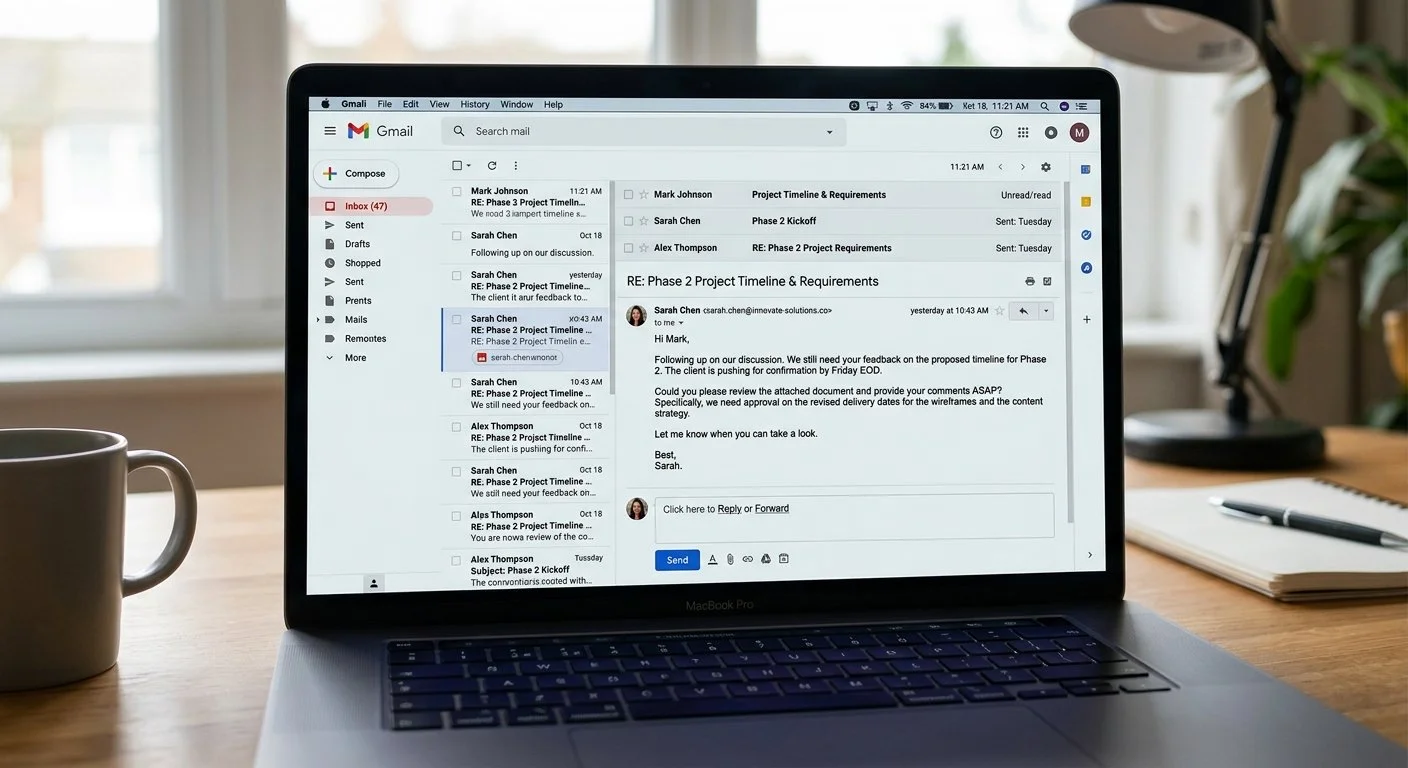
You wrote the email. You checked it twice. You hit send and then waited. Nothing came back.
It is easy to assume the person is busy, or that your email got buried, or that they mean to respond and just have not gotten around to it. Sometimes that is true. But if unanswered emails are a pattern rather than an occasional frustration, the problem is probably not on their end.
It’s in the email itself.
The subject line gets too much blame
Most advice about email response rates starts and ends with the subject line. Write a better subject line and people will open your email. That is true as far as it goes, but it stops at the wrong place. Getting someone to open the email is only the first problem. Getting them to respond is an entirely different one.
An email with a compelling subject line and a confusing body still does not get a reply. The subject line earned the open. The content lost the response. That is where most people's analysis ends and where the real problems begin.
The ask is buried or missing entirely
This is the most common reason emails go unanswered, and it is almost never intentional.
The writer knows what they need. They are so focused on providing context, being polite, and not seeming demanding that by the time they get to the actual request, it is four paragraphs in and phrased so gently it barely registers as a request at all.
The reader finishes the email, has a vague sense that something was being asked of them, and moves on to the next message intending to come back to it. They do not come back to it.
If your email has an ask, it needs to be clear, specific, and placed where the reader cannot miss it. Not buried in the third paragraph. Not softened into a suggestion. Not implied. Stated directly, early enough that the reader knows what the email is for before they have finished reading it.
The email requires too much work to respond to
Every email places a demand on the reader. The question is whether that demand is reasonable.
An email that asks three unrelated questions, requires the reader to locate an attachment, review a document, consult a calendar, and cc two other people before replying is not one email. It is five tasks dressed up as one. The reader looks at it, calculates the effort, and decides to handle it later. Later becomes never.
The fix is not always to send five separate emails. It is to be honest about what you are asking and whether the structure of your request makes it easy or hard to respond. If the ask is genuinely complex, acknowledge that. Give the reader a clear first step rather than the full picture all at once. Make the path of least resistance a reply, not a project.
The email is too long
Length is not always the problem, but it is often a symptom of one. Long emails are usually long because the writer has not decided what the email is actually for.
When the purpose is clear, the length takes care of itself. You include what the reader needs and leave out what they do not. When the purpose is unclear, everything feels potentially relevant and the email grows to accommodate the uncertainty.
A reader who opens a long email and cannot immediately see why it was sent to them will skim it, miss the important parts, and either reply with a question that was already answered in the email or not reply at all.
Before you write an email, finish this sentence: the one thing I need from this person is. If you cannot finish it, you are not ready to write the email yet.
The tone is off in a way that is hard to name
Some emails do not get replies because something about them feels wrong to the reader without the reader being able to articulate exactly what.
It might be that the email is too formal for the relationship and reads as distant. It might be that it is too casual for the context and reads as unserious. It might be that the writer is clearly frustrated and the reader does not want to engage with that energy. It might be that the email is technically polite but has an undertone of pressure that the reader registers and pulls back from.
Tone in writing is subtle. It is made up of word choice, sentence length, what is said and what is left unsaid. Readers feel it before they identify it. And when the tone is off, the instinct is often to delay responding rather than engage with whatever is creating the friction.
Reading your email aloud before you send it catches tone problems that silent reading misses. If you hear something that would make you hesitate to reply, the reader will too.
The timing works against you
This one is outside your control once the email is sent, but it is worth knowing. Emails that arrive on Friday afternoons, Monday mornings, or in the middle of a known busy period for the recipient are working against themselves before they are even opened.
This does not mean obsessively timing every message. It means being aware that an email sent at a low-attention moment is competing with everything else landing in that inbox at the same time, and that a follow-up is sometimes not a sign that your message was ignored but that it was received at the wrong moment.
The follow-up you are avoiding
Most people wait longer than they should to follow up and then feel awkward when they do. The follow-up gets delayed until it feels overdue, and then it gets written with an apologetic tone that signals the writer feels like they are imposing.
A follow-up is not an imposition. It is a normal part of professional communication. Send it sooner than feels comfortable, keep it short, and do not apologize for it. Reference the original email, restate the ask in one sentence, and make it easy for the reader to reply with a single line.
The goal is not to pressure anyone. It is to make responding feel like the path of least resistance.
The email that gets a reply
It has one clear purpose. The ask is specific and easy to find. It is short enough to read in under a minute. The tone matches the relationship. And it makes responding feel simple rather than effortful.
None of that requires a formula or a template. It requires knowing what you need, respecting the reader's time, and doing enough of the work upfront that replying takes them thirty seconds instead of thirty minutes.
That’s the email that gets answered.