
What Your Email Signature Says About You
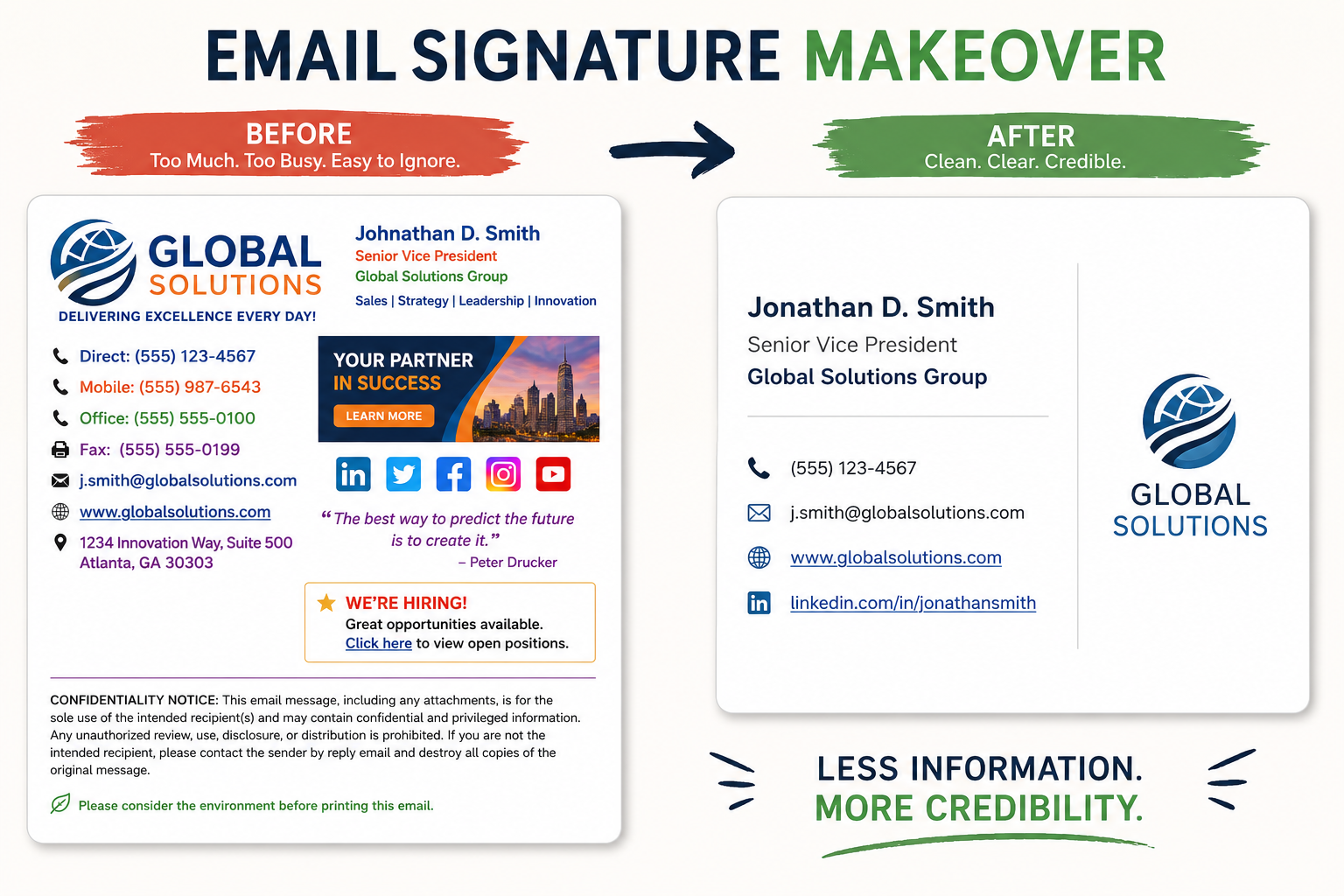
You probably set up your email signature a long time ago. Maybe when you started a new job, launched your business, or got tired of typing your phone number at the bottom of every message. You filled in the fields, picked a font, and moved on.
You have not thought about it since.
Here’s the thing: everyone you email has seen it. And whether you intended it or not, it has been telling them something about you every single time.
The signature nobody reads versus the one that does its job
An email signature has one job. It tells the recipient who you are, how to reach you, and in some cases, why they should take you seriously. That’s it. Four to six lines, done well, and the signature disappears into the background the way good design is supposed to.
When it is done poorly, it does not disappear. It announces itself.
What a cluttered signature communicates
Some signatures try to do everything at once. They include a full mailing address, three phone numbers, a fax number nobody uses, a headshot, a company logo, two social media icons, a banner ad for a current promotion, a legal disclaimer that runs six lines, and an inspirational quote attributed to someone famous.
The reader's eye doesn’t know where to go. More importantly, the signal that signature sends is not "I am a thorough professional." It’s "I have not made any decisions about what matters here."
Clutter in a signature mirrors clutter in thinking. Readers may not consciously register that, but they feel it.
What a missing or bare signature communicates
On the opposite end, a signature that contains only a first name, or nothing at all, creates friction. The recipient has to go looking for how to reach you. They have to scroll back through the thread to remember your last name or your title. That’s a small inconvenience, but small inconveniences accumulate into an impression.
A missing signature also signals that you have not considered the reader's experience. That’s worth considering.
The specific things people notice
Even when readers are not consciously evaluating a signature, certain elements register.
Title and company. If your title is vague or missing, people will fill in the gap with whatever they infer from context. If you are a founder, say founder. If you are a senior consultant, say so. Ambiguity does not read as humble. It reads as unclear.
Phone number. Including one signals that you are reachable and that you operate like a professional. Omitting it is fine in some industries and conspicuous in others. Think about your context.
The inspirational quote. This is a divisive choice. Some readers appreciate a well-chosen line. Many find it distracting or oddly personal for a business context. If you use one, ask yourself honestly whether it adds something or whether it is just there because it felt like a good idea five years ago.
Pronouns. Including pronouns in a signature has become standard in many industries and professional communities. In others it remains uncommon. It’s a choice that carries social and professional signaling in either direction, and it’s worth making deliberately rather than by default.
The legal disclaimer. If your company requires one, that’s not in your control. If you added one yourself because you saw other people doing it, know that most readers ignore them entirely and some find them off-putting in casual correspondence.
What a strong signature looks like
A signature that works is simple, complete, and consistent with how you want to be perceived.
It includes your full name, your title and company, one phone number, and a link to your website or LinkedIn if either is relevant. If your brand has a logo, one clean version at an appropriate size is fine. Nothing flashing, nothing oversized, nothing that requires a reader to scroll past it to get to the next email.
It should look the same across devices. A signature that renders beautifully on desktop and breaks into a stack of misaligned images on mobile is doing quiet damage every time someone opens it on their phone.
The test worth applying
Pull up your email signature right now and ask three questions.
Does it tell someone who you are and how to reach you within five seconds? Does it look intentional rather than assembled from defaults? And does it reflect the professional you are today, not the one who set this up three jobs ago?
If the answer to any of those is no, it’s worth ten minutes of your time to fix it. Your signature is in every email you send. It is doing work whether you think about it or not.
Make sure it is doing the right work.