
The Real Reason AI Won’t Replace Human Writers
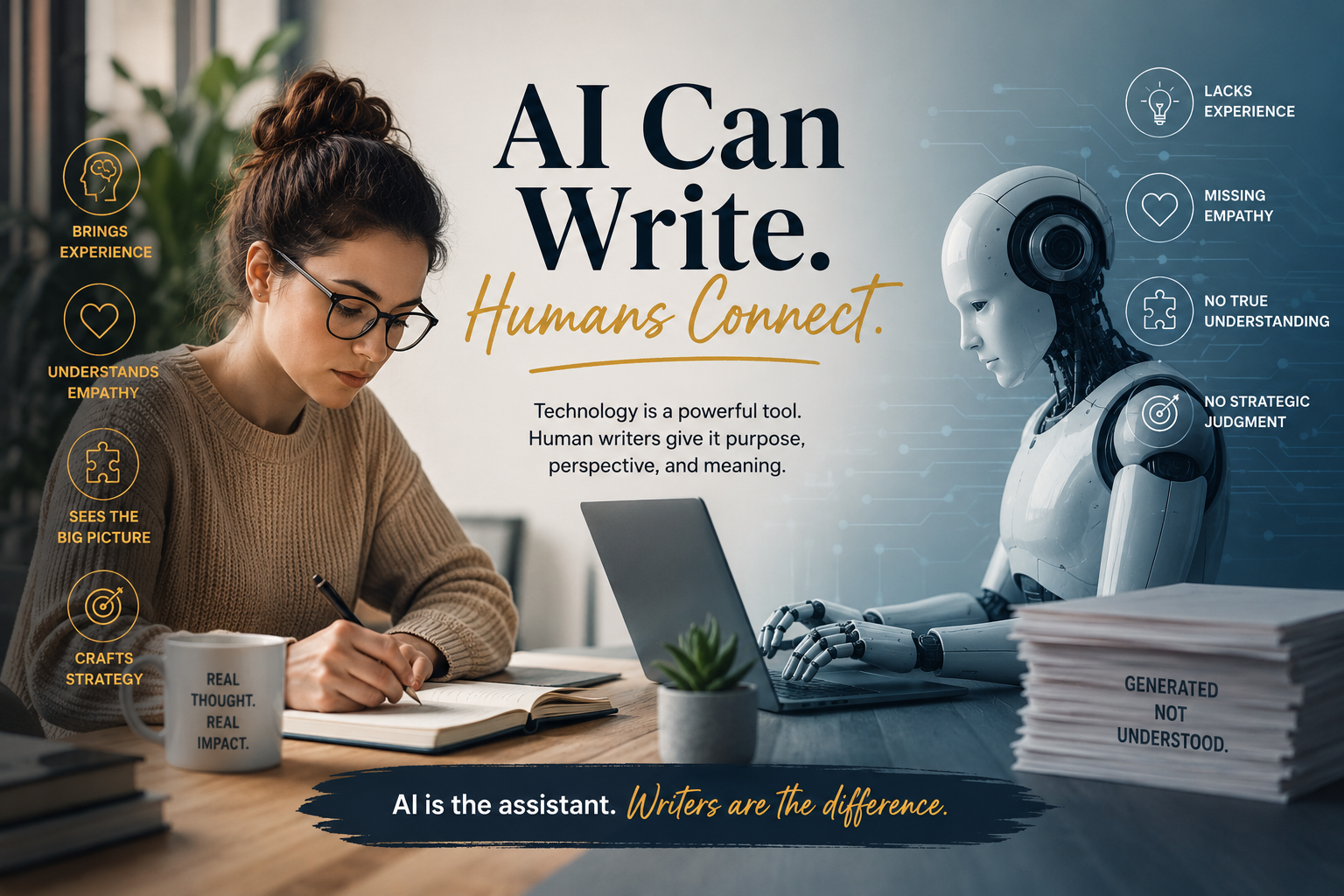
AI Changed Writing Fast. That Does Not Mean It Replaced Writers.
Artificial intelligence has transformed the way people create content. Articles, emails, product descriptions, social posts, and reports can now be generated in seconds. For businesses focused on speed and scale, AI looks impressive, and in many ways, it is.
That has also created a growing assumption that human writers are becoming unnecessary.
They are not.
AI is changing writing workflows, but it is not replacing the people who understand how communication actually works. Generating words and creating meaningful writing are not the same thing. One is prediction. The other is judgment.
That difference matters more than ever.
AI Can Produce Content, but Humans Create Meaning
AI is excellent at identifying patterns. It can mimic tone, summarize information, and structure readable text based on massive amounts of existing content. What it cannot do is genuinely understand why something matters.
Human writers bring context, perspective, emotional intelligence, and strategic thinking into communication. They understand audience psychology. They recognize nuance. They know when a message should sound confident, empathetic, persuasive, or restrained.
AI does not understand stakes. It does not understand timing, relationships, or cultural nuance in the way humans do. It predicts language based on probability, not lived experience.
That is why AI-generated writing often sounds technically correct while still feeling empty.
Brand Voice Cannot Be Fully Automated
Strong brands do not just share information. They communicate personality, values, and perspective consistently over time. That consistency builds trust and recognition.
AI struggles with this because it defaults toward average language. Its goal is fluency, not originality. Without human direction and editing, AI-generated writing often sounds interchangeable with everything else online.
Human writers shape voice intentionally. They know what a brand should sound like and, just as importantly, what it should not sound like. They make decisions that reinforce identity instead of flattening it.
As more companies rely on AI-generated content, authentic voice becomes even more valuable because generic writing becomes easier to spot.
Good Writing Requires Judgment
Writing is not only about assembling sentences. It involves deciding what to emphasize, what to leave out, and what the audience truly needs to hear.
That requires judgment.
A human writer can recognize when a message feels confusing, emotionally tone-deaf, overly corporate, or strategically weak. They can adapt communication based on audience reactions, market conditions, or cultural shifts.
AI cannot independently make those decisions with genuine understanding. It can imitate strong writing patterns, but it cannot think critically about the real world consequences of communication.
This becomes especially important in leadership communication, branding, crisis response, and persuasive writing where nuance matters.
The Internet Already Has Enough Generic Content
One unintended consequence of AI writing tools is the rapid increase in low value content. Businesses can now produce huge volumes of articles and posts quickly, but quantity does not automatically create trust or engagement.
Readers are already becoming better at recognizing generic AI-style writing. It tends to sound polished but repetitive, confident but shallow. The structure is predictable. The phrasing feels familiar. The insights rarely go deeper than surface level observations.
Human writers differentiate content by bringing originality, personality, and insight. They connect ideas in unexpected ways. They tell stories. They challenge assumptions. They create writing people actually remember.
That kind of communication is difficult to automate because it depends on perspective rather than pattern recognition.
AI Is a Tool, Not a Replacement
The most productive writers today are often the ones using AI strategically. AI can help brainstorm ideas, organize drafts, summarize information, and speed up repetitive tasks. Used correctly, it can improve efficiency significantly.
But efficiency is not the same thing as expertise.
Human writers still shape the message, refine the tone, challenge weak ideas, and ensure the communication achieves its purpose. AI assists the process. Humans direct it.
The companies seeing the best results are not replacing writers with AI. They are combining AI tools with experienced human editors and strategists who know how to turn raw output into effective communication.
Human Writing Builds Human Trust
At its core, writing is about connection. People want communication that feels thoughtful, credible, and real. They want to feel understood, not processed through a content machine.
That human element matters in marketing, leadership, customer relationships, and brand building. Trust is built through clarity, consistency, empathy, and perspective. Those qualities come from people.
AI will continue to reshape how writing gets produced. It will absolutely change workflows, expectations, and content volume. But replacing human writers entirely misunderstands what strong writing actually is.
Good writing is not just readable text. It is thinking, judgment, strategy, and human understanding translated into words.
And that part is still human.