
“Best in the World” Is a Claim, Not a Compliment
Recently, someone told me a product we work with was the only one in the world that does a particular thing.
The second I saw the word “only,” I wanted to prove it wrong. So I looked. It took very little time to find that it wasn’t the only one.
That reflex isn’t unusual. It’s what a competitor, a skeptical buyer, or a journalist does the moment they see an absolute. And once they find one counterexample, the claim is dead, and it can take your credibility on everything around it down with it.
Why absolutes are easy to write and expensive to defend
Words like “only,” “first,” “best,” “always,” and “never” feel strong. They sound decisive and confident, and they fit neatly into a headline.
But they have a built-in weakness. A normal claim can be a little off and still survive. An absolute has to be completely right, and it has to stay right. One competitor, one overseas product, one earlier launch, and it’s over.
There’s also a quieter cost. When a reader catches one overreach, they start to wonder what else you stretched. The claim you could have defended gets discounted along with the one you couldn’t.
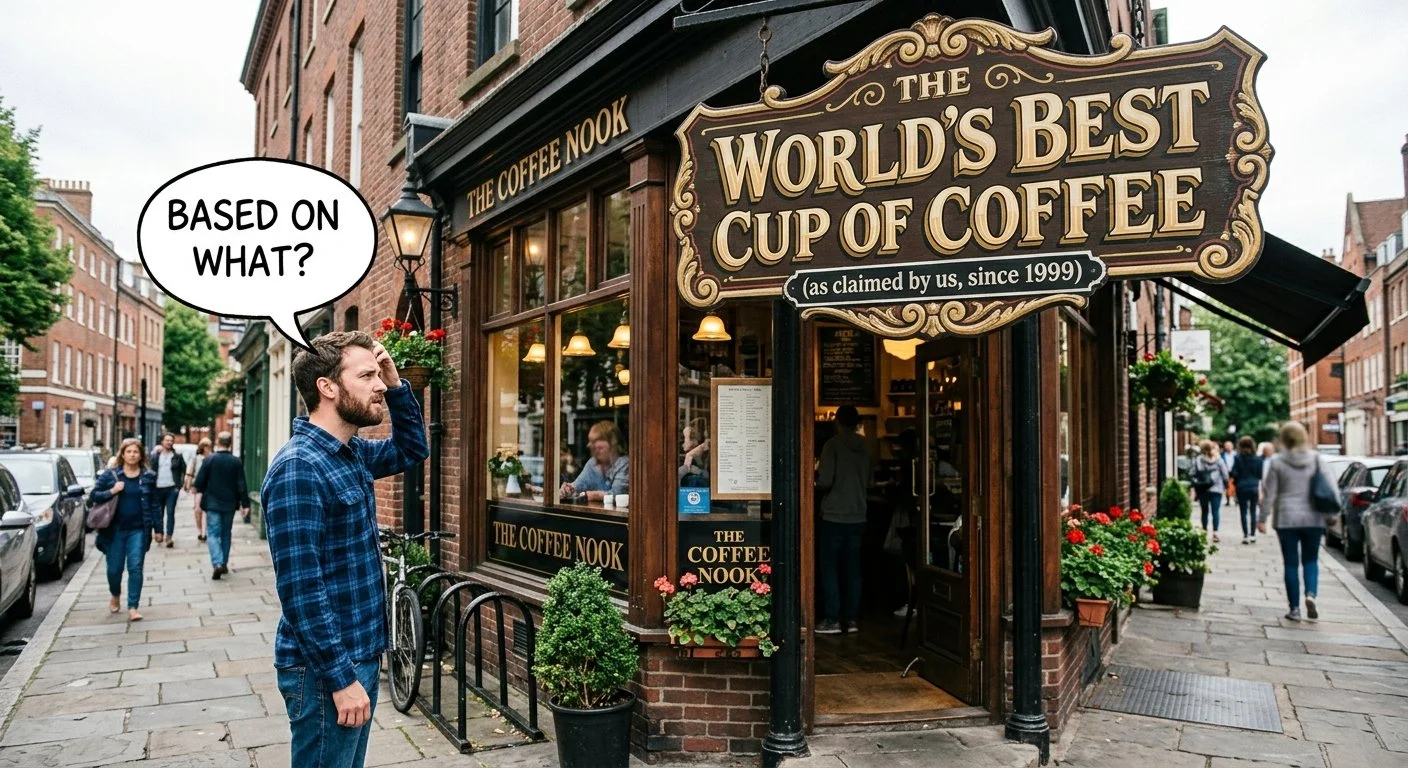
Remember the coffee shop in Elf
If you’ve seen the movie, you know the scene. A New York coffee shop has a sign out front congratulating itself on serving the world’s best cup of coffee, and Buddy reacts like they’ve achieved something extraordinary.
It’s funny because the claim is so confident and so unverified. Nobody checked. Nobody tasted every cup on earth. It’s just a sign.
That’s the best way to think about unchecked absolutes in your own writing. Someone made the claim, nobody looked into it, and it went up in big letters anyway.
The words worth a second look
Whenever one of these shows up in a draft, stop and ask what it’s based on:
Only
First
Best
Number One
Leading
Always / never
Every / all
Guaranteed
Unique
The world’s [anything]
You don’t have to ban them. You just have to be able to defend them.
Is “best in the world” actually a legal problem?
Sometimes, and it depends on context. A quick note before I go further: I’m a writer, not a lawyer, and this is general background for U.S. marketing, not legal advice. If a claim is going into an ad, a label, or a sales deck, run it past someone qualified.
In the U.S., the FTC expects advertisers to have a reasonable basis for objective claims before they publish them. The key word there is objective. Vague, exaggerated opinion that nobody could measure or prove, often called puffery, generally doesn’t need backup. “Best pizza in town” is the classic example.
Where it gets tricky is that the same word can land on either side. A superlative that suggests you’re measurably better than a competitor starts to look like a claim that needs proof, not just a boast. And if you say or imply that tests or studies back you up, you need the evidence you’re implying.
So “best” can be a harmless boast in one sentence and a claim you have to substantiate in the next. That’s a good reason to treat it as a claim from the start.
How to research a claim before you make it
Do what a skeptic would do.
Define exactly what you’re claiming. “The only product that does X” can mean very different things. The only one with this feature? At this price? In this country? Right now? Pin it down, because the narrower the claim, the easier it is to prove.
Search for the counterexample. Look up competitors, alternatives, and similar products. Check other markets and other countries. Search patents, marketplaces, and trade press. Try phrases like “alternatives to” and “similar to.” If you can find a counterexample in an hour, so can your audience.
Test it along every dimension. A product can be the only one with a given feature but not the only one at that price, or the first in your category but not the first overall. Check each version of the claim separately.
Have someone else try to break it. You’ll be biased toward your own claim. Hand it to a coworker and ask them to find the hole.
Remember what you didn’t find. “I couldn’t find another one” is not the same as “there isn’t another one.” That’s why “the only one we’ve found” is often the honest version.
How to document it
A claim is only as strong as the record behind it, and claims age. Competitors launch things, and last year’s “only” can become this year’s “one of several.”
For each claim, keep a simple file with:
The exact wording you’re using
What it’s based on, with links or copies of the sources
The date you checked, and who checked it
The scope (feature, market, price, time period)
A date to re-check it
If anyone ever asks “how do you know?”, you’ll have an answer in thirty seconds, not three days.
What to write instead
You can often keep most of the punch and lose most of the risk:
“The only one” becomes “the only one we’re aware of” or “one of the few”
“The first” becomes “the first in our category to offer X and Y together”
“The best” becomes a specific, true fact about what makes it good
“Always” becomes “usually” or “in our testing”
That last swap matters most. A specific, provable detail almost always beats a vague superlative. “Ready in ten minutes” is more persuasive than “the fastest in the world,” and nobody can find a counterexample to it.
Claim it only after you’ve checked it
Absolutes aren’t forbidden. Sometimes you really are the only one, and then you should say so loudly.
But say it because you checked, not because it sounded good. The best claims are the ones you’d be glad to have someone investigate.